

If Hurricane Helene taught operators in Western North Carolina anything, it was that repeaters can be both a critical asset and a point of failure during emergencies. In the days following the storm, access to key systems such as the N2GE and W4NYK repeaters enabled the coordination of resources and supplies for many in our area. However, when terrain, power loss, or equipment damage limited repeater access, direct station-to-station simplex communication remained an available option for local coordination.
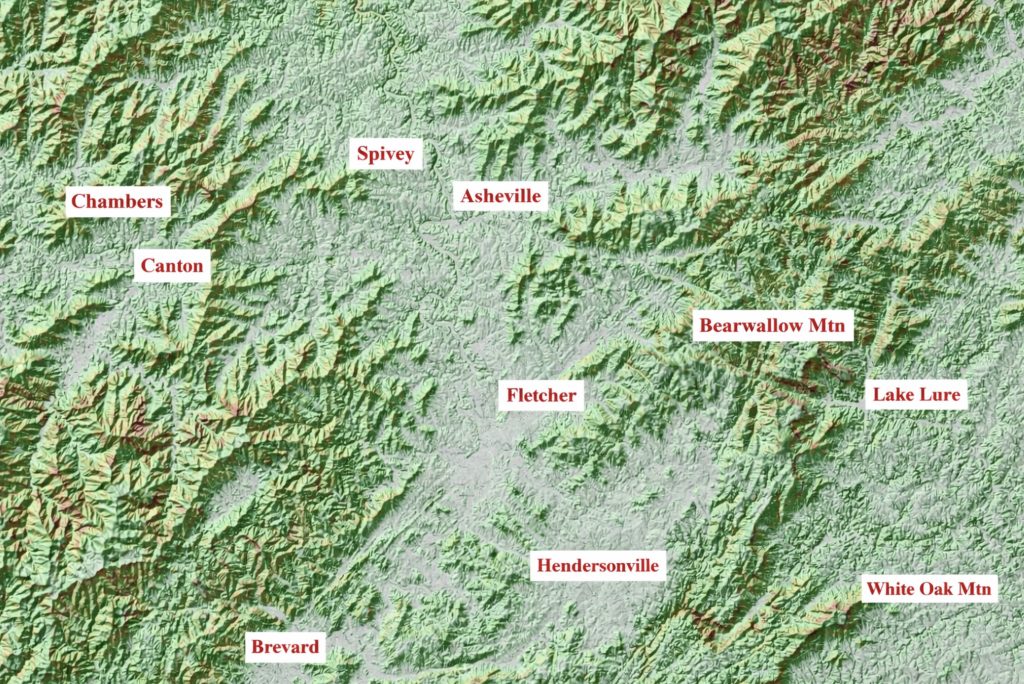
Operating radio in Western North Carolina demonstrates that effective communication is shaped as much by terrain and hands-on experience as by theory found in handbooks. Our region is defined by steep ridgelines, narrow hollows, deep river valleys, and rapid elevation changes over short horizontal distances. In this environment, understanding simplex is not optional for effective local communications; it is foundational.
Repeaters throughout Western North Carolina are typically sited to maximize population coverage or serve major transportation corridors. While they provide important regional connectivity, they do not consistently cover backcountry areas, isolated valleys, or ridge-to-ridge paths. Terrain shadowing can prevent access to repeaters even when they are geographically close. At the same time, nearby stations may be reachable via direct simplex paths from distant stations in the area. The National Interoperability Field Operations Guide (NIFOG) explicitly recognizes this reality and emphasizes simplex tactical operation when terrain or infrastructure limits repeater availability. This is why it’s good to practice.
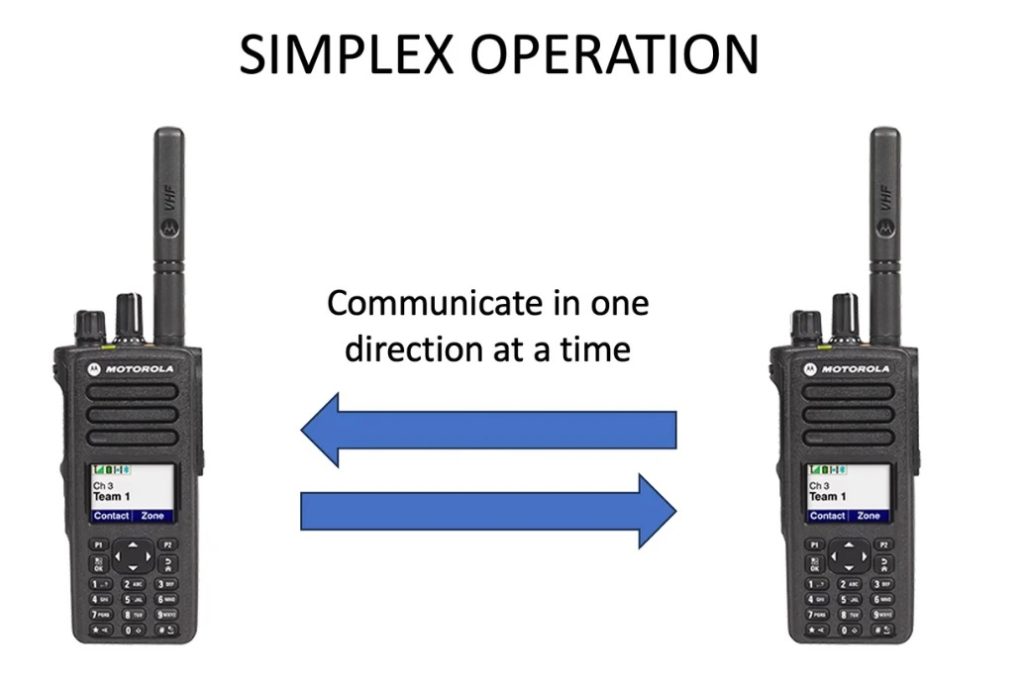
Propagation in Western North Carolina is strongly terrain-dominated, particularly on VHF and UHF. Antenna height relative to surrounding terrain is often more influential than transmitter power. Stations operating from ridgelines, knobs, or elevated clearings routinely achieve reliable simplex coverage with modest power levels, while higher-power stations located in valleys may experience significant attenuation. The ARRL Handbook for Radio Communications documents that improvements in antenna placement and terrain clearance usually yield greater performance gains than increases in power alone.
Band Selection
Effective simplex operation in Western North Carolina benefits from flexibility across multiple Technician class accessible bands rather than reliance on a single frequency range. 2M and 70cm remain the primary bands for local simplex communication due to widespread equipment availability, ease of operation, and compatibility with handheld and mobile radios. These bands are well suited for short-range and tactical communications, particularly when stations have reasonable line-of-sight or are operating from elevated terrain.
The 6M and 10M bands complement 2M and 70cm bands and should be considered viable options rather than specialty bands. 6M, occupying the boundary between HF and VHF, can sometimes support simplex paths that are unreliable on higher frequencies due to its longer wavelength and different interaction with terrain. 10M, while more dependent on band conditions, can provide regional simplex coverage under favorable circumstances and is generally more tolerant of foliage and terrain irregularities than VHF and UHF.
Rather than favoring one band exclusively, successful simplex operators in Western North Carolina evaluate 2M, 70cm, 6M, and 10M as a toolbox. Each band offers distinct propagation characteristics, and real-world performance varies significantly based on terrain geometry, station location, and operating mode.
FM and SSB as Complementary Modes
Mode selection has a significant impact on simplex effectiveness in mountainous terrain. FM is widely used on 2M and 70cm due to its audio clarity, operational simplicity, and compatibility with handheld radios. For short-range communications where signal strength is sufficient, FM performs well and supports efficient coordination among multiple stations. However, FM requires a relatively strong signal to remain intelligible. Once the signal falls below the capture threshold, audio quality degrades rapidly or drops out entirely, which is common in terrain where small changes in position can produce large variations in signal strength.
Single Sideband (SSB) provides important advantages for simplex operation under marginal conditions. SSB is commonly used and well established on 2M, 6M, and 10M, all of which are accessible to Technician-class operators. On 2M, SSB is widely employed for weak-signal and longer-distance simplex work and routinely succeeds where FM paths are unreliable. On 6M and 10M, SSB further extends usable range by requiring significantly less signal-to-noise ratio for intelligible communication. This makes SSB particularly effective for ridge-to-valley paths, partially obstructed terrain, and portable or field operations using modest power levels.
Of Note: While SSB operation is technically possible on 70cm, it is not commonly used for routine simplex or emergency communications. Higher feedline losses, polarization mismatch, and the need for highly directional antennas make 70cm SSB far less practical than 2M SSB for most operators, who typically turn to 2M when weak-signal simplex performance is needed.
Taken together, FM and SSB should be viewed as complementary rather than competing modes. FM is well suited for local tactical communication when signals are strong, while SSB provides additional margin and reliability when terrain or distance limits signal strength.
Infrastructure Limitations and Hurricane Helene
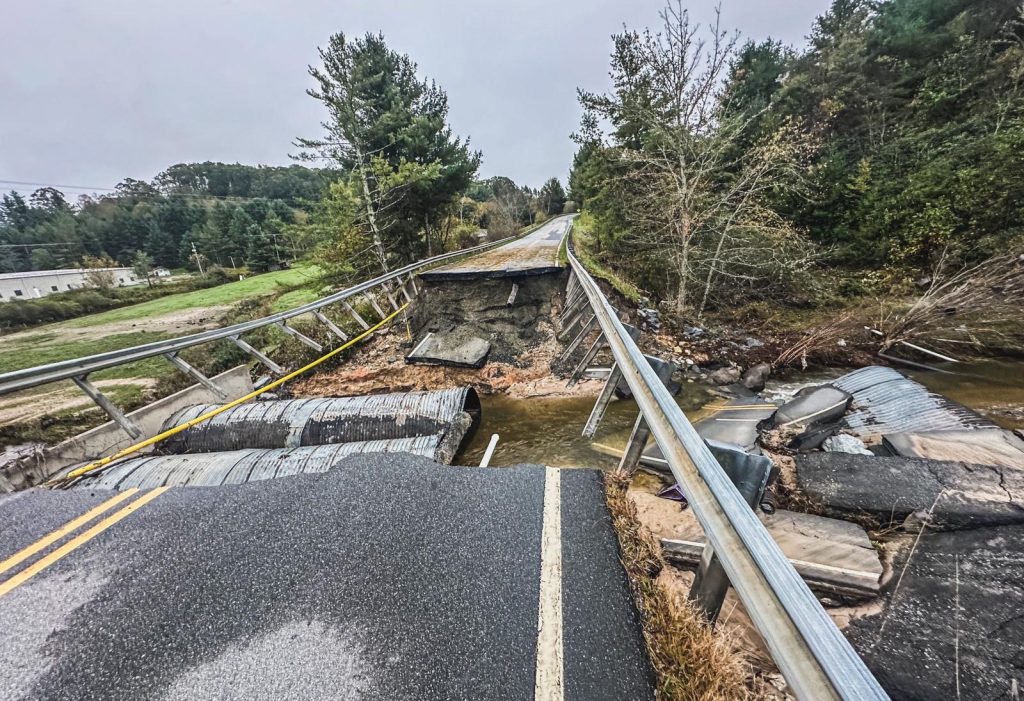
The importance of simplex operation in Western North Carolina was reinforced during Hurricane Helene, when widespread power outages and infrastructure impacts resulted in multiple repeaters becoming unavailable or operating with reduced reliability. Even repeaters that remained functional could have potentially been affected by site-specific power limitations, access constraints, or connectivity failures. During this period, operators who relied exclusively on repeaters may have experienced significant communication gaps, while simplex communication remained viable wherever terrain and station placement allowed.
Events such as storm highlight that simplex is not merely a contingency option, but a necessary operational capability in terrain-challenged regions like Western North Carolina.
The Importance of Local Testing
Simplex performance in Western North Carolina is highly location-specific. A frequency, band, or mode that works well from one ridge may fail completely a short distance away due to terrain shadowing or path geometry. Because of this variability, assumptions based solely on distance, power level, or equipment specifications are unreliable.
Empirical testing remains the only reliable method for understanding real-world propagation in complex terrain. Effective testing includes evaluating simplex paths across ridgelines, between valleys, and from known high points, as well as comparing FM and SSB performance across multiple bands. These tests provide practical data that can inform communication planning for public service events, emergency response, and routine operations. Several individuals and clubs across the area are setting up these tests to kick of 2026!
Wrapping-Up
In Western North Carolina, simplex communication is not simply a fallback when repeaters are unavailable. It is a primary operating method shaped by terrain, propagation, and operational experience. Technician-class operators who make effective use of simplex operations—and who understand the complementary strengths of FM and SSB—are better equipped to achieve reliable local communications. Regular testing, flexible band and mode selection, and attention to terrain-driven propagation are essential elements of successful simplex operation in this region.
Upcoming Simplex Net
To support continued learning and real-world evaluation of simplex performance in Western North Carolina, upcoming simplex nets are being planned. These net will provide an opportunity to test multiple bands and modes, evaluate terrain-dependent coverage, and compare FM and SSB performance under typical operating conditions. Details including date, time, frequencies, and operating guidelines will be published as they become available. The net schedules and frequencies have the potential to change so reach out to the point of contact for the latest information.
Nets: Upcoming Simplex Nets and Exercises
ARCWC Hosted – Bearwallow 6M Simplex Net Date: Every Friday · Time: 8:30 PM · Band: 6M See events calendar for frequencies, instructions, and contacts.
BRARS Monthly Simplex Net Date: First Tuesday each month · Time: 8:30 PM · Band: 2M See events calendar for operating details and points of contact.
Buncombe County Simplex Exercise Date: January 7, 2026 · Time: ~8:30 PM · Band: 2M See events calendar for frequencies, net control information, and guidance.
Thermal Belt 2M Simplex Exercise (TBARC) Date: TBD (2026) · Time: 8:00–8:30 PM · Band: 2M See events calendar for scheduling updates and full instructions.
Leave a Reply
You must be logged in to post a comment.